Showing posts with label classics. Show all posts

12.20.2013

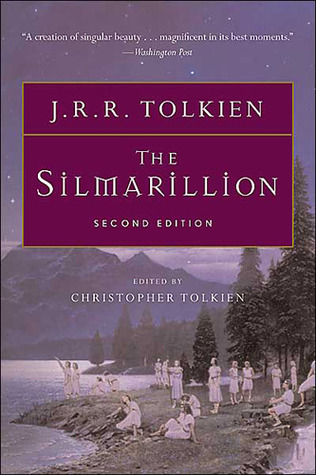
The Silmarillion

The Silmarillion
JRR Tolkien
Houghton Mifflin, 2001 (originally published 1977)

Oh. Stars. As a Tolkien fan for literally half my life, I'd never read The Silmarillion. Friends have talked about how tough a read it is, that it took three tries (or more) to finally slog through. They cautioned me about my pre-reading enthusiasm, and hoped I wouldn't be disappointed. Readers, I fell in love. From the earliest pages, I was caught hook, line and sinker. Head over heels.

I'm not even going to try to write a "formal" review. This isn't a book to be "reviewed" -- it's a book to be read, to be absorbed, to be loved. Richly, intricately detailed The Silmarillion is the history of Middle Earth's most awesome residents: the Elves. (Okay, so there's quite a bit of basic Middle Earth history too, but let's be honest: It's all about the Elves). At the risk of sounding like a mad woman, at times I felt as if I was reading my own history; that's how deeply I connected with this book. It's a novel, but not. It's a tome of history, but not. It's a collection of short stories, but not. It's, quite simply, Tolkien. With characters to love, to honor, and to abhor. With so many minute details and complex family relations that things become muddled even as they fall into clarity. It sets up the Tolkien most of us "know" with astonishing cohesiveness.

I think, having read The Hobbit and Lord of the Rings several times before, and thereby coming into this reading having some knowledge of the significance of what was happening, aided greatly in my understanding. The plan now is to reread those books again (very soon, we hope, since I read this back in August (oops)), and see what new elements I pick up on.

Book provided by my personal library.

5.24.2013

North and South (DVD)

 North and South
BBC, 2004
Starring: Richard Armitage & Daniela Denby-Ashe

While I ended up not watching this treasure with the Indie Janeites as planned, I did purchase and devour it after reading the book. Oh swoon. It was a wonderful viewing experience, and the BBC did a pretty good job of translating book to screen. Especially when you consider they took roughly 3-years-and-change of time and condensed it into a 4ish hour production. Impressive, my friends, impressive.

I'm willing to overlook some of the story-alterations as necessary evils for this condensing, although the one main issue I have is that they made Thornton mean. Proud, a little brash, controlled passion and a little rough around the edges? Definitely. But mean? Nope. So that bugged me a little, having become so acquainted with his character. I understand the "logic" behind the decision (give Margaret a reason to dislike him, quickly), but think it could have been handled differently. Otherwise, I'm okay with the way they played with the story.

DVD provided by my personal library.

5.21.2013

North and South

North and South
Elizabeth Gaskell
Penguin, 1996 (original publication 1855)

My journey to this book is an interesting one. Several years ago, a girlfriend suggested I give the BBC miniseries North & South a try, since I like Jane Austen miniseries so much. I tucked the recommendation away in my mental files, and it got lost. Then, on twitter, I saw where Kimberly Truesdale mentioned her next writing project, and got sucked into a hilarious conversation about superpowers, Mr Thornton (whom I knew nothing about) and Thorin Oakenshield (who I definitely have opinions on!) Out of that late night hilarity, we came up with the idea of an Indie Jane read-along of North and South, to culminate in a group watch of the miniseries (it stars the dreamy Dwarf King in a cravat. I kid you not). And so, the reading began ... and I was so, so hooked.

The story itself is ... well, it's quite a bit like Pride and Prejudice, actually. There's the girl (Margaret), who finds herself in reduced circumstances thanks to the nonthinking of her father, and who has been transplanted from the country South to the industrial North of England. And there's this guy (Thornton), who is a little brash around the edges - and definitely broody - not to mention substantially better off than the girl's family, and has been born and raised in this bustling industrial sector. Girl meets guy, and sparks fly. But not the dreamy romantic kind. Oh no, these two get along about as well as cats and rain. Margaret misses the quiet, clean, slower paced South, and fails to see how anyone could prefer the smoke and crowded noise of Milton. She soons finds herself making friends among the workers, and wrapped up in the middle of all the intricate ins and outs of mill town politics. Because her heart and sense of justice tell her things must change, but her prejudice prevents her from seeing the truth of Thornton's arguments. Oh yes, these two argue. It's delicious. And, of course, just as things might be beginning to sort themselves out "as they should," new complications arise by way of a clandestine visit from the outlaw brother, entirely too many deaths in quick succession, and the whisking away of Margaret from Milton back to London. Is all hope lost? Never! This is British literature we're talking about, and our dear writers never leave us in the lurch for long.

I delighted in this reading. There are lines that snagged my soul, and characters I loved to hate. And there's Thornton ... oh, Thornton. He tries so hard, he's so very rough and unpracticed. But he's real. He's flawed. He's human. He's totally on Darcy's level. And Margaret has such a sweet, sweet heart. It makes her prejudices more understandable, because she feels so much for everyone. I've rarely been prouder of a character however, than I was when she up and decided to tackle her life her own way, at the end. It was the perfect lead up to a lovely little encounter in the Library ... Definitely happy I was prodded into reading this gem. Now I can even more fully appreciate Kim's version when it comes out and I have a new author to pursue.

Book provided by my personal library.

10.31.2011

Northanger Abbey

Northanger Abbey
Jane Austen
Barnes & Noble Classic, 2005 [Originally published 1817]

I remember watching the Wishbone episode about Northanger Abbey years and years ago, and thinking it was a little weird. This was long before I was bosom buddies with Jane Austen, and as a late elementary/early middle school kid, Northanger Abbey just didn't capture my attention the way Joan of Arc and Ivanhoe did. The lingering sense of 'weirdness' kept me from visiting it once I was older and a confessing fan of Jane. But the ladies of Indie Jane have been telling me I must read it - if for no other reason than to meet Henry Tilney - so I decided to join their NA-Readalong.

Northanger Abbey is Jane's response to the Gothic novels sweeping through society. Catherine Moreland, our naive heroine, loves these novels, and much of her 'education' about society and people have come from them. Growing up in a happy-but-sheltered home, Catherine was unprepared for her 'debut' in society when family friends invite her to join them in Bath. Wholly out of her element, the first person Catherine meets is the too-smart-and-appealing-for-his-own-good Henry Tilney, who quite captures her attention. But soon Catherine makes new friends, who also end up being her brother's friends: Isabella and John Thorpe. The Thorpes are as far removed from the Tilneys as characters can get, and Catherine's attempts to figure everyone and everything out help us see into not only the story, but also society.

For me, the time in Bath was like a giant set-up for when the scene shifted to Northanger Abbey and Catherine's visit with the Tilneys. It was a time to get to know Catherine, and see how her mind works, how she sees the world and interacts with the people around her. It was also a time of wanting to throw a bucket of water on Isabella (she's not bad-bad, but she's the queen of catty divas) and duct tape John Thorpe's mouth not only shut, but also to his right knee. But I didn't really feel like the story was moving very much in Bath. Once we landed in Northanger however, things got going and I really enjoyed Catherine's story. Henry Tilney is a hero worth reading, and I loved how smart alecky he was - and that Eleanor (his sister) would turn around and give him what-for when he got too carried away with himself. Watching Catherine's ideas of romance grow was sweet, and rather realistic, I think.

On the whole, I'm glad I waited to read Northanger Abbey - I don't think I would have appreciated it as much when I was younger; as an ancient mid-twenties reader, I got more enjoyment out of the endeavor. Talking about it with the Indie Janeites every week was fun too!

Book provided by my local library.

8.29.2011

Sense & Sensibility

Sense & Sensibility
Jane Austen
Modern Library, 1940 (original copyright: 1811)

Oh, Jane...This was a 'comfort read' for me that also happened to neatly align with the Bicentennial Challenge I'm participating in over at Austenprose. It's been years since I read Sense & Sensibility (the real one, not a modern retelling), and I was very excited to see how it compared with both my memory and the film versions I watch frequently. I was not disappointed. There's so much to Jane, even though she merely writes about normal people living fairly normal lives. But there's a magic to the telling, and in Sense & Sensibility, it gains a special persuasion - perchance because I can see so much of my life, of the lives of my friends, reflected in the telling. This is a real story, about things that still happen.

For something as familiar and beloved as Austen, I don't want to write so much as 'review' as my response to the novel...As stated earlier: it was a comfort read. Familiar, cozy, you know exactly how it's going to end - but with every reading there is a new discovery of the characters, the story, yourself. I see so much of myself in Elinor - for all the 'fire & ice' hidden away inside my core, I do my very best to present a more composed front to the world (particularly those not a part of my inner circle). Do I succeed? Not always. I am not possessed of what you call a 'poker face.' But the point is: I can relate so very, very much to Elinor and her struggles. Marianne? Now her I just want to shake until her teeth rattle and her brains settle. Sense & Sensibility is a very reader-response text for me, obviously. I have very personal reactions and interactions with the characters (including falling for Edward, harder every time), I get into the story and taste that world. Personally, I find this evidence of Austen's success at writing - if you are able to draw me into the world you've written, kudos and brownie points coming your way.

I am very happy to have spent the time revisiting this classic comfort read, and while I look forward to delving into other versions and variations of the story - I am definitely going to come back to Sense & Sensibility before another ten years passes.

Book provided by my personal library.

11.18.2010

[Everything Austen II] Emma

Everything Austen II is a challenge hosted by Stephanie over at Stephanie's Written Word.
The goal: To read 6 Austen-themed works between July 1, 2010 and January 1, 2011.
The progress so far:
1: Persuasion (Jane Austen)
2: Emma (Jane Austen)
3:
4:
5:
6:

Emma
Jane Austen
Bantam Classics, 1984 (original publication 1815)

I read Emma ages ago, back in early high school. Probably sophomore year? I remember liking the story at the time, but at 15 there was no way I could possibly appreciate it the way I did now, rereading at the ripe old age of 25. This go-round, I was able to not only delight in the writing itself -- this may be the best written of Austen's novels, in my opinion -- but to lose my heart to the story, the characters, the whole shebang.

Perhaps one of the reasons I got so much more out of the novel this time was because for the first time in my life, I can actually relate to Emma Woodhouse. (I've watched the movies a dozen times, so I'm intimately acquainted with the story itself, if not as familiar with reading the words). I keep hearing that people do not like Emma as a character, and I'm not sure why. She's no Lizzie Bennett, but I find Emma refreshingly human. So she's spoiled and vain - she has every reason to be, and there is a good heart underneath the silliness. I found her a bit flippant at times, but attributed it to her youth and comparative isolation from society. What I did get a wee bit frustrated with was her inability to see Mr. Knightley. I fell in love with Mr. Knightley, really and truly, and found him to be a rival of Mr. Darcy for the title of "Perfect Romantic Hero".

Emma has much to offer the ready reader: a love story of aching sweetness and possibility; a host of characters that reflect all the best and worst of humanity; moments of dialogue that could be overheard in any college hall or coffee shop; and that special flavor that Jane gives to her best work. A delightful experience, and I shall revisit Emma again before another 10 years passes.

Book provided by my personal library.

7.26.2010

[Everything Austen II] Persuasion

Everything Austen II is a challenge hosted by Stephanie over at Stephanie's Written Word.
The goal: To read 6 Austen-themed works between July 1, 2010 and January 1, 2011.
The progress so far:
1: Persuasion (Jane Austen)
2:
3:
4:
5:
6:


Persuasion
Jane Austen
Signet Classics, 1996 (original publication 1817)

I have read at least 3, if not 4, contemporary retellings of Austen's Persuasion - so I was very familiar with the story. Several of my close friends love it, calling it their favorite Austen of all. So I went into this with high hopes and a happy sense of anticipation. And then I struggled my way through it ... I love Jane, but I definitely do not love Persuasion. At all. You can tell that this novel was written as she was "running out of time" sotospeak, and was not able to go back and rework everything -- it's almost like a second, maybe third draft, and one more good revision would have done the trick. The story's there, the characters have some promise, but it's just not quite clicking. The best of the whole book are Chapters 10 and 11 of Volume 2 -- coincidentally, the only two chapters Jane went back and did serious reworking of (or so says the introduction in my volume). You can tell. There's a difference to the story in those two chapters.

Anne Elliot annoyed me. I wanted to shake her until her teeth rattled in her head and she woke up. They say she shows amazing patience -- to me, she showed immense passivity. Did she feel things? Yeah, to varying degrees. But she was just so ... complacent and accepting of everything. I got increasingly frustrated with her as the course of the novel continued. Captain Wentworth was not a bad hero - but I'd like to get to know him better. He had a humanity to him, a normal, familiar pride about him, that reminded me of Darcy. Perhaps if the Captain were written more, Anne would be more appealing and the story revived greatly.

Unfortunately, strangely, the original Austen is lacking in story and likeability to the contemporary retellings.

Book provided by my personal library.